Late Notes · A monologue by Soraya Darzi
At sixty-seven, I bought a notebook for the life I was about to begin. It was an expensive notebook, which seemed appropriate. I had waited forty years to have nothing scheduled.
On the first page I wrote the date.
For several weeks, that was the book.
I am seventy-six now. I can tell this story without the embarrassment I felt while living it, though I still have the notebook. My handwriting on that first page is unusually firm. A woman reporting for duty.
I had retired from teaching. Friends called it early retirement, which amused me: sixty-seven is early chiefly to people who imagine an elderly woman as an unfinished source of labor. Still, I understood them. I was well. I could work. I had chosen the door.
Afterward I stood outside it, waiting for someone to tell me where to go.
I continued waking before six. I dressed with the old care. By eight I had eaten, read the news, and washed the cup. A whole day remained. This happened every morning. The abundance began to feel accusatory.
People had plans for me. Travel. Learn something. Volunteer. Write the book. Their suggestions were kind, and each arrived with the faint outline of an assignment. I considered making a timetable for being free.
What I found hardest to admit was how young I felt. I could discuss a difficult poem with a roomful of students. I could move between languages, prepare an argument, survive a meeting. Yet I could not enter an ordinary Tuesday with confidence. I felt like a child left at the wrong gate.
There is a particular shame in being old enough to know that you are fortunate and still being unhappy. I was able to leave. I had a home. The money arrived. None of this told me what to do after washing the cup.
The child entered through a question about keys.
A young woman downstairs had gone into labor. Could I keep a spare set in case her sister arrived while they were at the hospital? I had known her mostly through parcels and the occasional apology about noise. Later there was a request to bring up a bag, then to sit for twenty minutes while she showered. The twenty minutes acquired successors.
I belonged to no branch of the family. I had no title the baby would eventually be instructed to use. I was a person upstairs who could sometimes come down.
At the beginning she slept against my chest with the solemn concentration of someone doing essential work. I could feel her small weight changing as she settled. Once her mother returned and found me still in my coat. I had been afraid that taking it off would disturb her.
I had spent years teaching people to interpret words. For a time, in that room, I was occupied by a breathing sound.
I watched a hand become useful to its owner. At first it passed before her face like an unexpected visitor. Later she could get it to her mouth. Later still she could take hold of my finger and object when I wanted it back.
I began to recognize the pauses before an attempt. The face gathered itself. An arm set out. Something failed to happen. Then the effort started again.
During those months I was trying to read in the afternoons. It sounds a ridiculous difficulty for a woman who had spent her life among books. But my reading had always leaned toward an occasion: a class, a review, a person to whom I would explain something. Alone, I sometimes put a book down after three pages and wandered to the kitchen.
Watching her reach, I became less eager to make an accusation out of my own unfinished attempts.
Of course I was tempted to turn her into a little philosopher. An educated woman can be a nuisance in this way. Give her a baby dropping a spoon and she will discover an argument about existence.
The child had practical concerns. She wanted the spoon. Then she wanted to drop it. Then she wanted me to retrieve it with the same amazement I had shown the first time.
I obliged for a while. Afterward I said, “You have seen what happens.”
She looked at me, held the spoon over the edge, and opened her hand.
I admired her unwillingness to accept my summary.
Her first movements across the room made distance visible to me. A chair leg became a destination. The stretch of carpet between two adults became a considerable country. I began taking walks without deciding in advance how far they needed to go. Some days I reached the park. Some days I bought bread and came home.
She was growing stronger. I was getting older. Our futures were different, and I never mistook our situations for the same thing. But we could share a room while neither of us knew quite what to do next. That was a relief I had not found in advice.
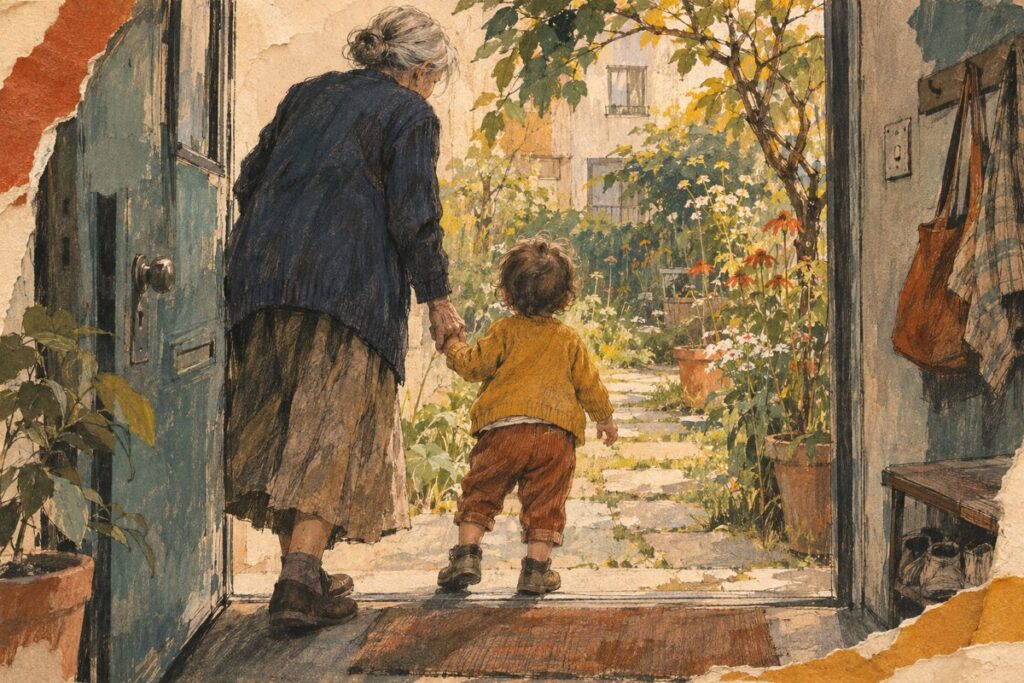
At nineteen months she had several words, preferences of startling firmness, and a way of entering my apartment as though she had come to inspect the management. She knew where I kept the wooden bowl. She knew a cupboard I preferred her to forget. She would bring me my shoes and stand waiting while I put them on.
Once, ready to go out, she stopped at the doorway. A leaf was caught on the step. She bent to pick it up, lost her balance, recovered, and tried again. I waited with my keys in my hand.
By then I had learned to wait through things I could have done more quickly myself. I was less accomplished at giving myself that courtesy.
I still wanted to be able to report progress. When an old colleague asked what I was doing, I heard my answer become overelaborate. I listed reading, a possible essay, some help for a neighbor. I made the small activities sound like the departments of an institution.
Then I went home and found a wooden block in my coat pocket.
I do not remember her putting it there. It was red, with a chipped corner. I set it beside the expensive notebook.
I would like to say that I then understood how to live. There were more mornings of restlessness. There were afternoons when the child exhausted me and I was grateful to return her to her mother. Love did not make me endlessly available. I learned to say when I could come, and when I needed to stay upstairs.
But the days began to contain things I had no wish to turn into achievements. A sound she made when water ran into the bath. The pressure of her hand when she wanted help over the step. My own absorption in a page I had finally forgotten to prepare for someone else.
I remember one morning when she brought my shoes and I asked her where we were going.
She pointed through the door with magnificent imprecision.
I checked that I had the keys. She held out her hand.
We went as far as the leaf.
Soraya Darzi is a fictional Broken Zine persona. Late Notes is a series of imagined monologues and reflective essays.